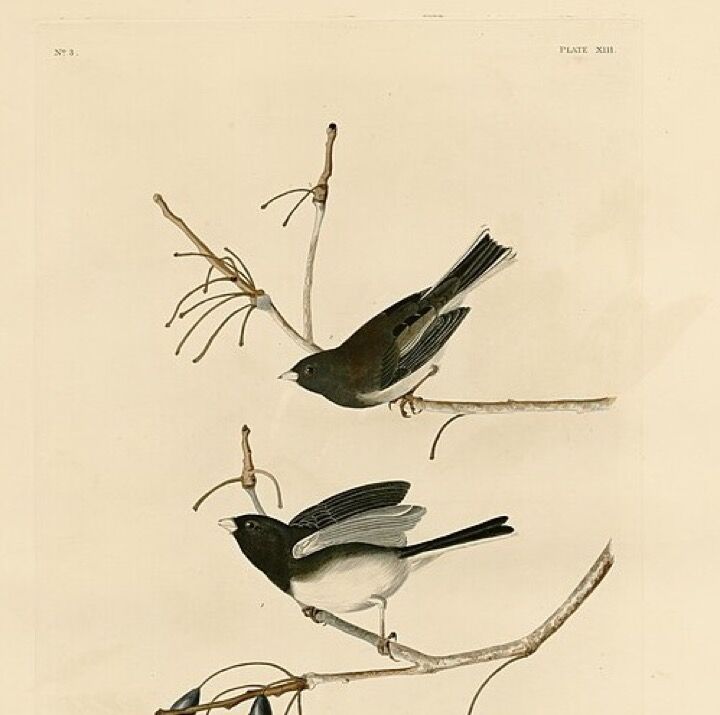
Dark-eyed Junco · Junco hyemalis
When do Dark-eyed Juncos arrive?
- States with dates
- 30
- All year or winter
- 19
- Typical accuracy
- ±1 day
Source: eBird Observation Dataset (Cornell Lab of Ornithology) via GBIF, records 2015–2025, CC BY 4.0; summarized into typical dates, not a forecast. Data updated Nov 16, 2026; refreshed once a year when GBIF publishes a new eBird release. Methodology · Report an error
Dark-eyed Juncos, often called snowbirds (Missouri Department of Conservation), take about 42 days to spread from North Dakota to Louisiana. In 19 states (Alaska, Arizona, California, Colorado, Idaho and others) they are around all year or mostly in winter, so those pages show monthly patterns. Checked against 2025, our typical dates were off by 1 day in a typical state; 30 of 30 states were within a week.
Map: when Dark-eyed Juncos arrive
One square per state, shaded by the typical fall arrival date. Darker is earlier; the chart below gives each state’s date and range.
Arrival by state
Earliest states at the top.
All states
| State | Typical arrival | Most years | Spring departure | 2025 check |
|---|---|---|---|---|
| North Dakota | Oct 1 | Sep 28 – Oct 5 | Apr 25 | ±1 day |
| Minnesota | Oct 6 | Oct 2–8 | Apr 25 | ±0 days |
| Wisconsin | Oct 10 | Oct 8–12 | Apr 23 | ±1 day |
| Michigan | Oct 12 | Oct 10–14 | Apr 25 | ±1 day |
| Iowa | Oct 17 | Oct 13–20 | Apr 13 | ±1 day |
| Massachusetts | Oct 17 | Oct 15–27 | Apr 21 | ±1 day |
| Illinois | Oct 17 | Oct 14–20 | Apr 17 | ±2 days |
| Nebraska | Oct 18 | Oct 14–20 | Apr 10 | ±1 day |
| Connecticut | Oct 19 | Oct 18–28 | Apr 16 | ±1 day |
| Rhode Island | Oct 19 | Oct 15–24 | Apr 14 | ±2 days |
| New Jersey | Oct 21 | Oct 18–24 | Apr 14 | ±1 day |
| Ohio | Oct 23 | Oct 20–26 | Apr 20 | ±0 days |
| Pennsylvania | Oct 23 | Oct 22–31 | Apr 21 | ±0 days |
| Indiana | Oct 24 | Oct 21–28 | Apr 13 | ±1 day |
| Kansas | Oct 25 | Oct 23–30 | Apr 7 | ±6 days |
| District of Columbia | Oct 25 | Oct 19–28 | Apr 15 | ±2 days |
| Delaware | Oct 26 | Oct 24 – Nov 4 | Apr 11 | ±0 days |
| Missouri | Oct 27 | Oct 25–29 | Apr 7 | ±2 days |
| Maryland | Oct 29 | Oct 28 – Nov 5 | Apr 12 | ±1 day |
| Virginia | Oct 31 | Oct 29 – Nov 5 | Apr 14 | ±0 days |
| Kentucky | Oct 31 | Oct 27 – Nov 3 | Apr 8 | ±1 day |
| Oklahoma | Oct 31 | Oct 29 – Nov 3 | Apr 2 | ±2 days |
| Tennessee | Nov 1 | Oct 27 – Nov 3 | Apr 15 | ±1 day |
| Arkansas | Nov 2 | Oct 31 – Nov 5 | Apr 2 | ±1 day |
| Texas | Nov 5 | Nov 1–7 | Apr 2 | ±1 day |
| Mississippi | Nov 8 | Nov 5–12 | Mar 31 | ±1 day |
| Alabama | Nov 9 | Nov 4–12 | Apr 3 | ±3 days |
| Georgia | Nov 9 | Nov 6–10 | Apr 20 | ±3 days |
| South Carolina | Nov 11 | Nov 7–13 | Apr 4 | ±1 day |
| Louisiana | Nov 12 | Nov 9–13 | Mar 26 | ±4 days |
| Alaska | All year | n/a | n/a | n/a |
| Arizona | All year | n/a | n/a | n/a |
| California | All year | n/a | n/a | n/a |
| Colorado | All year | n/a | n/a | n/a |
| Idaho | All year | n/a | n/a | n/a |
| Maine | All year | n/a | n/a | n/a |
| Montana | All year | n/a | n/a | n/a |
| Nevada | All year | n/a | n/a | n/a |
| New Hampshire | Passage visitor | n/a | n/a | n/a |
| New Mexico | Passage visitor | n/a | n/a | n/a |
| New York | Passage visitor | n/a | n/a | n/a |
| North Carolina | All year | n/a | n/a | n/a |
| Oregon | All year | n/a | n/a | n/a |
| South Dakota | Passage visitor | n/a | n/a | n/a |
| Utah | All year | n/a | n/a | n/a |
| Vermont | Passage visitor | n/a | n/a | n/a |
| Washington | All year | n/a | n/a | n/a |
| West Virginia | Passage visitor | n/a | n/a | n/a |
| Wyoming | All year | n/a | n/a | n/a |
Too few sightings for a date in Florida.
Get ready
Product searches on Amazon. We are not paid for these links.