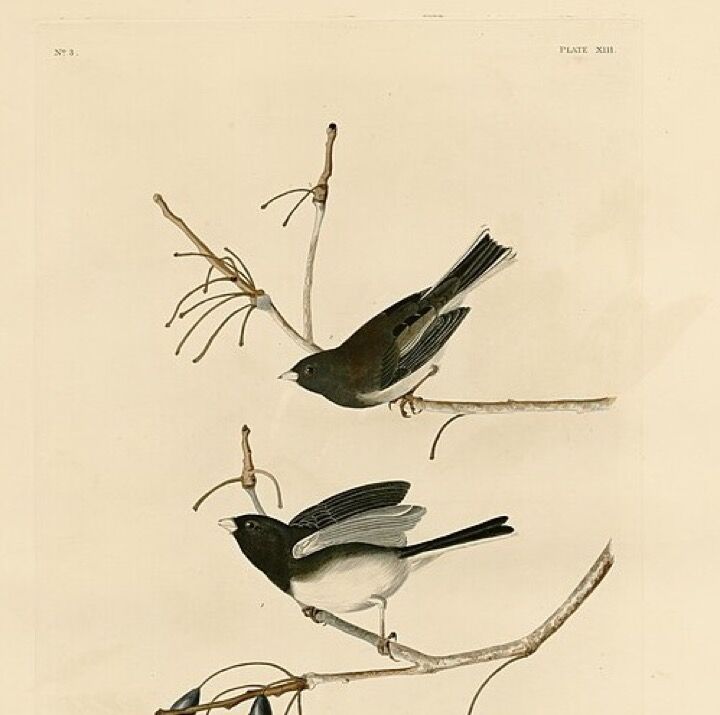
Dark-eyed Junco · Idaho
Dark-eyed Juncos in Idaho, month by month
- Peak month
- Dec
- Fewest sightings
- May
- Off-season level
- 18% of peak
Source: eBird Observation Dataset (Cornell Lab of Ornithology) via GBIF, records 2015–2025, CC BY 4.0; summarized into typical dates, not a forecast. Data updated Nov 16, 2026; refreshed once a year when GBIF publishes a new eBird release. Methodology · Report an error
What to expect
Dark-eyed Juncos are reported in Idaho in every month, so there is no single arrival date. In the June-July lull, their share of all bird reports is still 18% of the peak month (December). The low point is May.
- They become common again, climbing halfway from their summer level to their fall peak, around October 5 (most years Sep 28 to Oct 31, 11 years).
- This is when they become common again, not when the first one is seen.
- The rise is erratic from year to year: 2019 came earliest (Sep 28) and 2016 latest (Nov 9), 42 days apart.
- Our 2015-2024 date (Oct 4) missed 2025 by 12 days, so read this date loosely.
- Of the 13 states with this pattern, Idaho has the weakest off-season presence; California has the strongest.
- Based on 106,155 sightings from 2015 to 2025.
Month by month
How common Dark-eyed Juncos are in Idaho each month, all years combined.
Show the monthly table
| Month | Percent of all sightings | Compared with the peak |
|---|---|---|
| January | 4.13% | Near the peak |
| February | 4.17% | Near the peak |
| March | 3.28% | About half the peak or more |
| April | 1.29% | A quarter to half of the peak |
| May | 0.52% | Low point |
| June | 0.76% | Under a quarter of the peak |
| July | 0.88% | Under a quarter of the peak |
| August | 0.69% | Under a quarter of the peak |
| September | 1.14% | Under a quarter of the peak |
| October | 3.23% | About half the peak or more |
| November | 4.11% | Near the peak |
| December | 4.65% | Peak month |
The fall rise, year by year
Show the table
| Year | Sightings | Rise date | Compared with typical |
|---|---|---|---|
| 2015 | 5,444 | Sep 29 | 6 days early |
| 2016 | 5,008 | Nov 9 | 35 days late, unusually |
| 2017 | 5,726 | Oct 2 | 3 days early |
| 2018 | 6,781 | Oct 11 | 6 days late |
| 2019 | 8,576 | Sep 28 | 7 days early |
| 2020 | 12,393 | Oct 5 | On the typical date |
| 2021 | 12,309 | Oct 10 | 5 days late |
| 2022 | 11,309 | Oct 31 | 26 days late, unusually |
| 2023 | 12,766 | Sep 28 | 7 days early |
| 2024 | 12,884 | Oct 2 | 3 days early |
| 2025 | 12,959 | Oct 15 | 10 days late, unusually |
Nearby states
| State | Pattern | Off-season level | Common again |
|---|---|---|---|
| Montana | All year, more off-season sightings | 39% | Oct 6 |
| Nevada | All year, more off-season sightings | 47% | Oct 26 |
| Oregon | All year, more off-season sightings | 44% | Oct 15 |
| Utah | All year, more off-season sightings | 21% | Oct 11 |
| Washington | All year, more off-season sightings | 61% | Oct 8 |
| Wyoming | All year, more off-season sightings | 41% | Sep 30 |
Farther away, the most similar pattern: North Carolina (18% of peak, common again Nov 7), Colorado (23% of peak, common again Oct 15), Maine (24% of peak, common again Oct 13), Arizona (40% of peak, common again Oct 20).
More birds in Idaho
- American Robins all year
- Black-billed Magpies all year
- Mallards all year
- Canada Geese all year
- House Finches all year
- Song Sparrows all year
- Northern Flickers all year
- European Starlings all year
- Red-winged Blackbirds all year
- Mourning Doves all year
- Red-tailed Hawks all year
- Common Ravens all year
- Black-capped Chickadees all year
- Eurasian Collared-Doves all year
- House Sparrows all year
- American Goldfinches all year
- Red-breasted Nuthatches all year
- American Kestrels all year
- American Crows all year
- California Quail all year
- Killdeers Mar 14
- Great Blue Herons all year
- Lesser Goldfinches all year
- White-crowned Sparrows passage visitor
- All 234 birds in Idaho
Get ready
Paid links to Amazon searches. As an Amazon Associate I earn from qualifying purchases. Buying through them costs you nothing extra.
Email me before they arrive
Enter your ZIP code and we'll email you about 10 days before Dark-eyed Juncos usually reach your county in Idaho. Never more than one email a day.