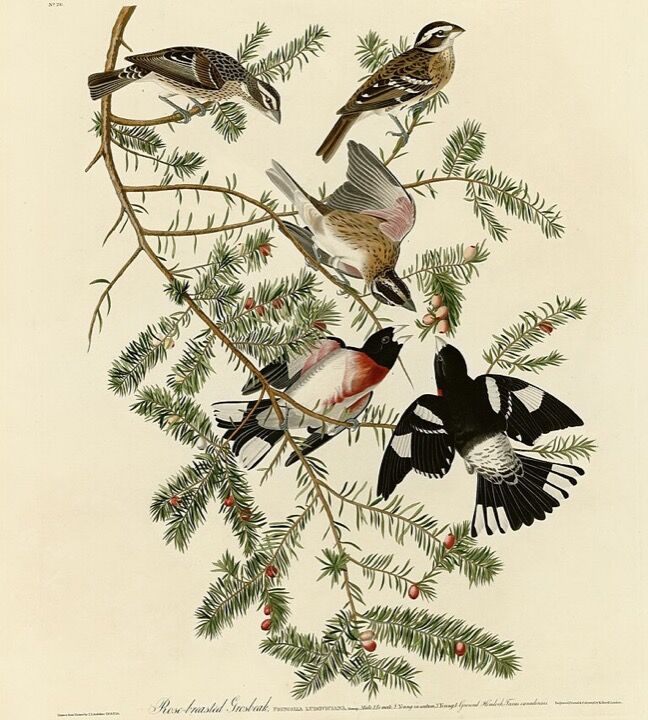
Rose-breasted Grosbeak · Texas
When do Rose-breasted Grosbeaks arrive in Texas?
Source: eBird Observation Dataset (Cornell Lab of Ornithology) via GBIF, records 2015–2025, CC BY 4.0; summarized into typical dates, not a forecast. Data updated Nov 16, 2026; refreshed once a year when GBIF publishes a new eBird release. Methodology · Report an error
Through the year
How common Rose-breasted Grosbeaks are among all bird sightings in Texas, day by day, 2015–2025.
What to expect
Rose-breasted Grosbeaks usually reach Texas around April 17, the day the first 10% of spring sightings are in. In most years from 2015 to 2025 that date fell between Apr 15 and Apr 18, based on 51,137 spring records.
- The Rose-breasted Grosbeak date barely moves here: 3 days separate the earlier and later years, and even the extremes (2016 on Apr 15, 2024 on Apr 19) are only 4 days apart.
- Timing varies inside the state: across 15 counties with enough sightings, Cameron County is earliest (Apr 12) and Bexar County latest (Apr 26), 14 days apart.
- In 2025 they arrived on Apr 15, 2 days earlier than the ten years before.
- Allowing for how many people were out birding, the date comes out at Apr 16, within 1 day, so busy birding weekends are not skewing it.
- The wave arrives fast: half of the spring sightings are in by Apr 25, just 8 days after the first arrivals.
- Texas is one of the early states, 5th of 42. The biggest gap with a neighbor is New Mexico, 15 days later.
Year by year
The arrival date in each year, 2015–2025.
Show the table
| Year | Spring sightings | Arrival | Compared with typical | Half arrived | Activity-adjusted | Fall departure |
|---|---|---|---|---|---|---|
| 2015 | 2,235 | Apr 15 | 2 days early, near normal | Apr 24 | Apr 15 | Nov 11 |
| 2016 | 2,746 | Apr 15 | 2 days early, near normal | Apr 23 | Apr 14 | Oct 19 |
| 2017 | 3,103 | Apr 18 | On the typical date | Apr 26 | Apr 20 | Nov 16 |
| 2018 | 3,733 | Apr 18 | On the typical date | Apr 26 | Apr 17 | Nov 12 |
| 2019 | 3,709 | Apr 18 | 1 day late, near normal | Apr 27 | Apr 17 | Nov 9 |
| 2020 | 3,249 | Apr 17 | On the typical date | Apr 27 | Apr 15 | Nov 4 |
| 2021 | 5,976 | Apr 17 | 1 day early, near normal | Apr 24 | Apr 14 | Nov 7 |
| 2022 | 5,335 | Apr 18 | On the typical date | Apr 25 | Apr 16 | Nov 8 |
| 2023 | 8,796 | Apr 16 | 1 day early, near normal | Apr 25 | Apr 17 | Nov 11 |
| 2024 | 5,651 | Apr 19 | 1 day late, near normal | Apr 24 | Apr 18 | Nov 9 |
| 2025 | 6,604 | Apr 15 | 2 days early, near normal | Apr 26 | Apr 14 | Nov 7 |
When they leave
Most have gone by November 9 in a typical year: 90% of fall sightings are in by then, and only stragglers are seen after. It ranged from Nov 4 to Nov 12 in most years, and 2017 ran latest (Nov 16). Allowing for birdwatcher activity, sightings drop below half their fall peak after about Nov 10. Our 2015-2024 date (Nov 9) missed the 2025 departure by 3 days.
By county
15 Texas counties have enough sightings for their own date. Earliest: Cameron County (Apr 12), Jefferson County (Apr 14), Brazoria County (Apr 17). Latest: Bexar County (Apr 26), Travis County (Apr 26), Williamson County (Apr 25).
Show all 15 counties
| County | Arrival | Compared with state | Sightings | 2025 check |
|---|---|---|---|---|
| Cameron County | Apr 12 | 5 days earlier | 5,237 | ±11 days |
| Jefferson County | Apr 14 | 3 days earlier | 3,938 | ±8 days |
| Brazoria County | Apr 17 | Same | 1,919 | ±10 days |
| Galveston County | Apr 17 | Same | 13,109 | ±11 days |
| Nueces County | Apr 18 | 1 day later | 4,527 | ±0 days |
| Chambers County | Apr 19 | 2 days later | 1,111 | ±12 days |
| Harris County | Apr 20 | 3 days later | 3,234 | ±0 days |
| Aransas County | Apr 20 | 3 days later | 904 | ±4 days |
| Fort Bend County | Apr 21 | 4 days later | 884 | ±1 day |
| Hidalgo County | Apr 21 | 4 days later | 1,055 | ±2 days |
| Montgomery County | Apr 21 | 4 days later | 471 | ±2 days |
| Brazos County | Apr 23 | 6 days later | 671 | ±2 days |
| Williamson County | Apr 25 | 8 days later | 373 | ±4 days |
| Travis County | Apr 26 | 9 days later | 1,182 | ±0 days |
| Bexar County | Apr 26 | 9 days later | 330 | ±0 days |
Nearby states
| State | Typical arrival | Difference | Fall departure |
|---|---|---|---|
| Arkansas | Apr 24 | 7 days later | Oct 14 |
| Louisiana | Apr 15 | 2 days earlier | Oct 27 |
| New Mexico | May 2 | 15 days later | n/a |
| Oklahoma | Apr 29 | 12 days later | n/a |
Farther away, the closest timing: Mississippi (Apr 18, 1 day later), Alabama (Apr 16, 1 day earlier), Georgia (Apr 19, 2 days later), Florida (Apr 15, 2 days earlier).
More birds in Texas
- Northern Cardinals all year
- Northern Mockingbirds all year
- Mourning Doves all year
- White-winged Doves all year
- Turkey Vultures all year
- Great-tailed Grackles all year
- Carolina Wrens all year
- Blue Jays all year
- Carolina Chickadees all year
- Great Egrets all year
- House Sparrows all year
- Black Vultures all year
- Red-winged Blackbirds all year
- Great Blue Herons all year
- American Crows all year
- European Starlings all year
- House Finches all year
- Eastern Phoebes all year
- Yellow-rumped Warblers Oct 31
- Red-bellied Woodpeckers all year
- Barn Swallows Mar 21
- Killdeers all year
- Ruby-crowned Kinglets Oct 19
- Black-crested Titmice all year
- All 459 birds in Texas
Get ready
Paid links to Amazon searches. As an Amazon Associate I earn from qualifying purchases. Buying through them costs you nothing extra.
Email me before they arrive
Enter your ZIP code and we'll email you about 10 days before Rose-breasted Grosbeaks usually reach your county in Texas. Never more than one email a day.
Share it on your site
Bird clubs, nature centers and garden shops can add a free badge with the Texas arrival window. It links back here and carries the data credit.
Get the badge